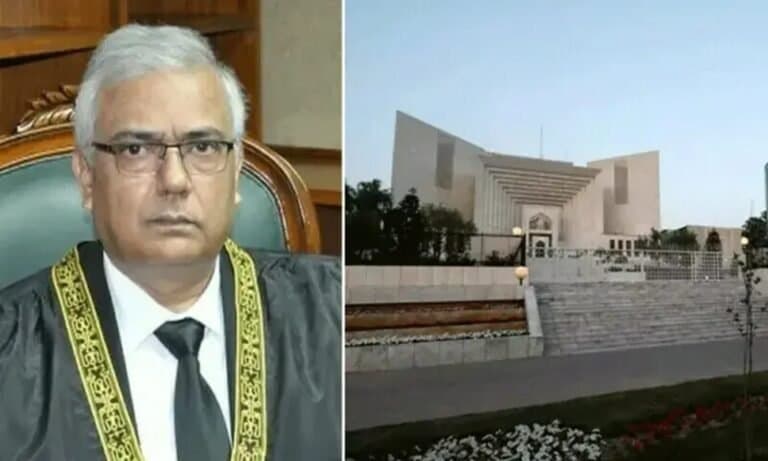



The Federal Constitutional Court has issued an important written judgment on a long-standing dispute over the division of property and inheritance, ruling that errors in the mutation of inheritance or mere technical mistakes cannot deprive any heir of their Shariah share, ARY News reported on Tuesday.
The 11-page judgment, authored by Chief Justice Aminuddin Khan, upheld the Lahore High Court’s decision and dismissed all appeals filed in the case.
The court held that kinship or blood relation alone does not decide the division of inheritance, and the absence of a direct male heir does not automatically make a near relative entitled. Property must be divided under Islamic inheritance law and the prescribed legal categories, the judgment said.
The court clarified that after the fixed Shariah shares of the widow and sisters are distributed, the remaining property belongs to the ‘asaba’ — the legal male relative — and where a legal asaba exists, the principle of ‘radd’ (redistribution) cannot be applied.
In this case, the court ruled that after the fixed shares were distributed, the remaining share belonged to the deceased’s paternal cousin, upholding his legal claim. The court added that mere revenue entries or paperwork formalities cannot change a person’s actual Shariah right.