

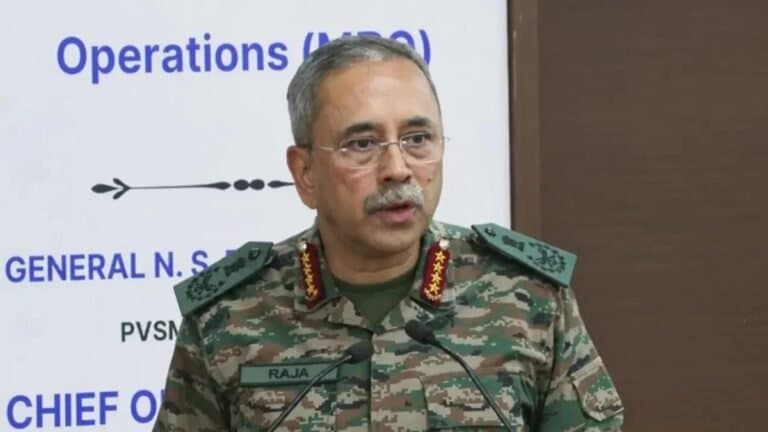
India’s Chief of Defence Staff, General N. S. Raja Subramani, has said that Pakistan’s space capabilities are improving with help from China, and that India must take this into account in its strategic planning.
General Subramani made the remarks on Friday, 27 November, at the Vivekananda International Foundation in New Delhi, where he was speaking at a session on the future of warfare and India’s preparedness to conduct multi-domain operations.
According to reports of his address, he said: “Pakistan’s space capability is improving with Chinese help. Also, Pakistan’s Suparco is working to develop its own capability. Now we also have to take it for granted that it will be aided by the Turkish too.”
He said that whatever intelligence, surveillance and reconnaissance, positioning, navigation and timing capabilities China has could become available to Pakistan, adding that this was a factor India would have to consider as it plans for the future. He argued that India could not afford to ignore the possibility.
The Indian defence chief stressed that India must strengthen its own military space capabilities. He pointed to the Space Based Surveillance programme, known as SBS Phase-III, under which India plans to build a network of dedicated military satellites to support its armed forces.
The SBS Phase-III programme, worth Rs26,968 crore, envisages 52 dedicated military satellites being launched over three years. It was approved by the Cabinet Committee on Security in October 2024 and is being implemented under the Defence Space Agency, which coordinates the military’s space requirements. The satellites are intended to improve surveillance from orbit, giving the armed forces a clearer picture of developments on the ground and at sea.
His comments underline how space has become a central part of security calculations in the region, alongside land, sea, air and cyber operations. Military planners in both countries have increasingly treated satellites as essential for communication, navigation and surveillance. What the Indian military chief described was his own assessment of the changing balance, and the remarks were reported as his view rather than as an independently confirmed account.
Pakistan’s space programme is run by the Space and Upper Atmosphere Research Commission, known as Suparco, which the Indian general said was working to develop its own capability.