

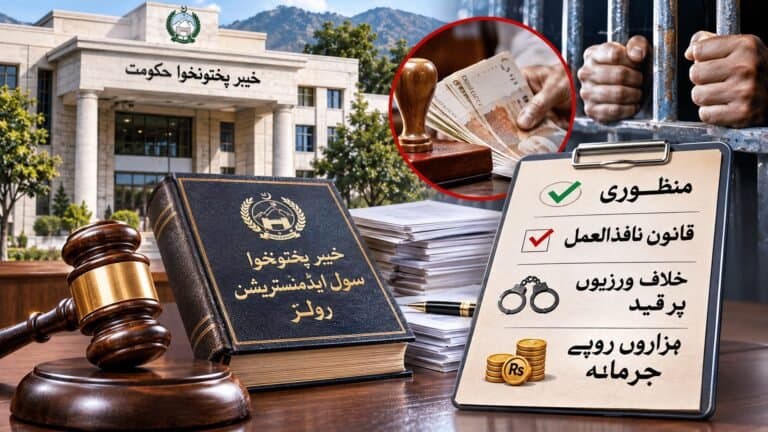
Peshawar — The Khyber Pakhtunkhwa government has notified the Civil Administration (Public Service Delivery and Good Governance) Rules 2026, nearly six years after the provincial assembly passed the Civil Administration Act. Under the new rules, 17 violations can attract up to six months in prison and fines of up to Rs30,000.
According to the notification, administrative penalties have been fixed under Section 24 of the Act, with details set out in Rule 20 and the schedule attached to the rules.
Seventeen serious violations
The schedule lists 17 violations, including obstructing an authorised officer, holding an unauthorised public gathering, creating environmental hazards, illegally storing hazardous waste, tampering with official or public records, selling or transporting prohibited items, and endangering public safety. Offenders can face up to six months’ imprisonment and a fine of up to Rs30,000.
Other violations — minor encroachments, poor sanitation, non-compliance with official orders, overcharging transport fares, noise pollution, negligence in waste disposal, lack of safety arrangements, unauthorised advertising and obstructing government offices — will attract fines of Rs10,000 to Rs30,000. Part B of the Second Schedule lists 10 minor offences, fined Rs2,000 to Rs3,000 on a first violation.
Under Rule 20, a citizen who is not a government employee and violates directions from a district administration officer or authorised authority must pay the scheduled fine. A repeat offence will be treated as an offence under Section 24(2) of the Act. All offences under the rules will be cognizable by police, and the competent court will conduct a summary trial.
Placement committee for officers
Rule 5 provides for a Provincial Placement Committee to recommend officers for the posts of commissioners and deputy commissioners. It will send a panel of suitable officers to the chief minister and meet monthly to propose panels on performance, conduct, ability, integrity and suitability. Service records, length of service and any pending inquiry will reach the chief minister through the chief secretary.
Digital record of government property
Under Rule 11, deputy commissioners must compile a record of government properties at district level and maintain a digital registry in the format given in the First Schedule. Department heads must also protect government property from misuse, embezzlement, damage, illegal occupation and encroachment, and keep a digital record of what they own.
Strict conditions for gatherings
Rule 13 bars any person or group from holding a public gathering or procession without the prior written permission of the deputy commissioner or the authorised officer. Permission may carry conditions on timing, venue, route and procedure. Organisers must apply in writing at least nine days before the event, stating its purpose, venue and duration, with an affidavit carrying at least two sureties. The officer must decide within five days.
The Act was passed by the provincial assembly nearly six years ago, but the delay in framing the rules meant most provisions could not be effectively enforced. At the grassroots level, officers lacked a clear legal procedure for problems such as illegal encroachments, overcharging and environmental pollution.
With the rules in force, the district administration has an effective tool for swift action and summary trials, while tying postings to monthly performance and a panel system should reduce political interference in transfers. The nine-day application and surety conditions for gatherings, however, could prove a tough new test for political and social circles.