

ADاشتہار / AdvertisementGoogle Ad
HomePakistanPakistan Urges UN to Regulate Social Media, AI and Digital Payments Used to Fund Terrorism
Pakistan Urges UN to Regulate Social Media, AI and Digital Payments Used to Fund TerrorismPakistan
Pakistan’s ambassador to the UN has called for international regulation of social media, artificial intelligence and digital payment channels that terrorists use to move money, at a Security Council debate on counterterrorism financing.
Share:
Pakistan has urged the international community to regulate social media, artificial intelligence, gaming platforms and digital payment channels that terrorist groups exploit to raise and move funds, warning that new technology has made terrorism financing faster and harder to detect.
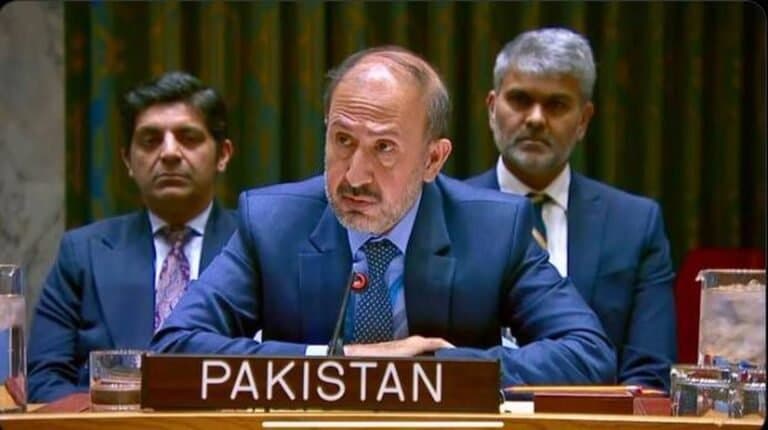
Ambassador Syed Haider Shah, Pakistan’s Permanent Representative to the United Nations, made the call in a statement at a high-level open debate of the UN Security Council in New York on strengthening counterterrorism through international cooperation, focused on preventing terrorism financing and incitement to terrorism.
ADاشتہار / AdvertisementGoogle Ad
Ambassador Shah said Pakistan is among the biggest victims of terrorism in the world, having lost more than 90,000 people and billions of dollars in economic losses. He said that in the past three years alone, more than 4,700 Pakistanis have been killed in terrorism emanating from Afghanistan, including attacks by the groups Pakistan calls Fitna al-Khawarij, the Tehreek-e-Taliban Pakistan, and Fitna al-Hindustan, the Balochistan Liberation Army.
He drew the Council’s attention to the links between terrorism and organised crime, including the transnational financing networks of the Islamic State of Iraq and the Levant-Khorasan, the Tehreek-e-Taliban Pakistan and its affiliates, the Balochistan Liberation Army and its Majeed Brigade, and the Eastern Turkistan Islamic Movement. He said these groups are involved in illicit narcotics trafficking, human trafficking, extortion, kidnapping for ransom, smuggling and cybercrime, and use hawala and cryptocurrency channels to move and launder funds. He said they also use front companies, including non-profit organisations, to raise and move money, and called on UN member states to enforce the recommendations of the Financial Action Task Force.
As new technology emerges, terrorists have adapted by exploiting social media, artificial intelligence, gaming platforms, virtual currencies, encrypted communications and digital payment methods, making terrorism financing faster, more concealed and harder to detect and disrupt, he told the Council.
The ambassador reaffirmed Pakistan’s call for regulating these tools and platforms, including measures to prevent their misuse by terrorists, stressing that this would require a collective international effort, as terrorists now operate across borders and jurisdictions.
He said the counterterrorism sanctions regime has to be more responsive, more effective and comprehensive, and must remain credible, targeted and evidence-based, addressing all forms of terrorism.
Ambassador Shah welcomed the adoption of a resolution updating the implementation of resolution 1373, an initiative that has been in the works for over a year. He said the resolution emphasises a comprehensive approach to countering terrorism and violent extremism, acknowledges that the digital space can be misused by terrorists, and underscores the need to integrate women into peace processes. He noted that this year marks the 25th anniversary of the adoption of resolution 1373 and of the September 11 attacks, and highlighted the role of the Counter-Terrorism Committee and its Executive Directorate, established under resolution 1535 (2004).
Ambassador Shah, who took up his post as Pakistan’s Permanent Representative to the UN earlier this month, said Pakistan will remain steadfast in its fight against terrorism and looks forward to working with the Security Council to strengthen international cooperation in counterterrorism.
The debate comes as the Council discusses threats from Afghanistan-based groups, with Dunya News reporting the UN counterterrorism chief warning that such groups pose a threat to member states.
Related Coverage